Key Takeaways
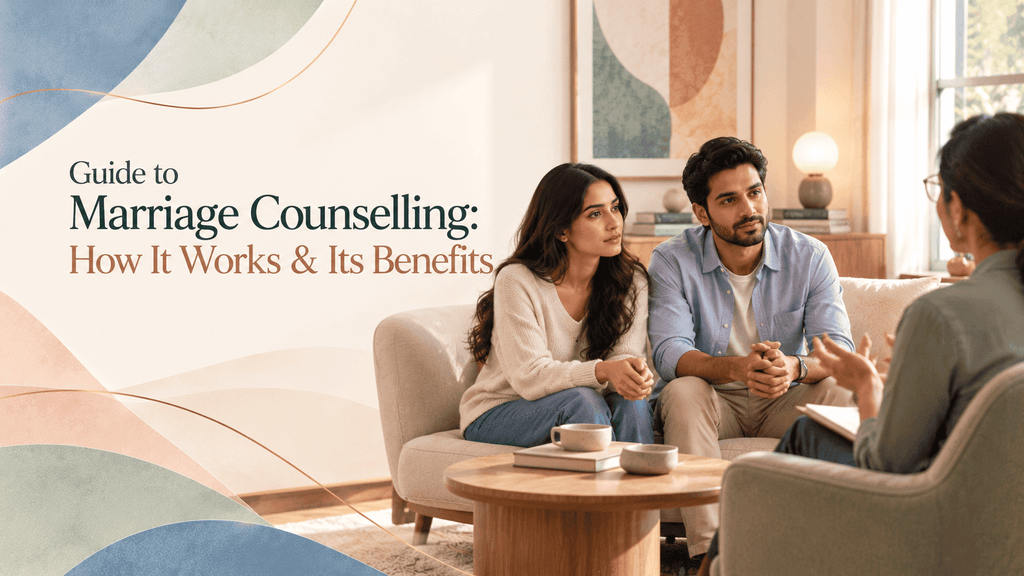
Marriage and relationship counselling provides a structured, therapist-led space to navigate emotional disconnection, recurring conflict, and broken trust. Rather than taking sides or assigning blame, professional counselling helps partners uncover unspoken expectations, rebuild communication patterns, and establish mutual respect.
Progress is measured by practical daily behavioral changes and emotional clarity, whether partners want to rebuild connection, resolve conflicts, or gain greater relationship clarity.
What Is Marriage and Relationship Counselling?
They still share meals, responsibilities, and familiar routines, but their conversations have become careful and short. One partner feels unseen; the other feels that nothing they do is ever enough. Neither imagined that a once-comfortable relationship could feel so lonely.
Marriage and relationship counselling is a structured form of professional support that helps people explore their experiences with a qualified practitioner trained to facilitate constructive conversations. The emphasis is not on handing down a verdict or assigning blame, but on identifying meaningful questions, understanding context, and deciding what changes the individual or partners wish to attempt. Professional boundaries, consent, and suitable qualifications matter as much as warmth. The methodology is explained in clear language and practitioner explains the approach, goals, and expected process clearly.
How Do I Know If I Might Benefit From marriage or relationship counselling?
You may consider this approach when unspoken expectations, emotional loneliness, resentment and strained trust begin to affect wellbeing, connection or ordinary decisions. Difficulty does not have to reach a crisis before it deserves attention. At the same time, no online checklist can determine whether one particular form of therapy is needed. The starting point is a thoughtful conversation about the concern, the people involved, immediate safety, personal preferences and what a useful outcome might look like.
How Does Relationship Counselling Work?
Relationship counselling helps individuals and couples understand how their personal experiences, emotional needs and communication patterns influence their relationships. During sessions, a counsellor explores recurring disagreements, unresolved concerns and the expectations each partner brings into the relationship. The focus is not on deciding who is right or wrong, but on identifying what causes misunderstandings and how both partners can respond more constructively.
A key part of counselling involves learning to express emotional needs without blame or criticism. For example, instead of saying, “You never make time for me,” a partner may learn to communicate, “I feel disconnected when we don’t spend quality time together.” This approach encourages clearer communication, reduces unnecessary defensiveness and creates opportunities for mutual understanding.
The counselling process is adapted to the couple’s concerns, emotional readiness and willingness to participate. Some couples may need support with rebuilding trust, while others may focus on recurring arguments, emotional distance or difficulties setting boundaries. A counsellor should adjust the pace of discussions, encourage feedback and avoid pressuring either partner into decisions before they feel ready.
Relationship counselling can also benefit individuals attending without their partners. Individual sessions may help someone understand relationship patterns, clarify personal expectations, establish healthy boundaries and make informed decisions. However, individual counselling cannot guarantee changes in a partner who is not participating.
To make progress measurable, the counsellor and client establish realistic therapeutic goals, such as improving communication, managing disagreements or responding more calmly during difficult conversations. These goals can be reviewed throughout the counselling process, with practical exercises introduced where appropriate.
When can it help, and what are its applications?
Common reasons to seek support include trust after hurt, competing life priorities, emotional neglect, extended-family boundaries, pre-marriage doubts, separation uncertainty and rebuilding mutual respect.
- These concerns frequently overlap: what appears to be a communication difficulty may also involve exhaustion, beliefs about worth, financial worries or unresolved experiences.
- A practitioner considers the broader situation rather than promising that one method will address every underlying cause.
- Support may also be useful preventively, before distance or distress becomes entrenched.
What happens during a session?
The first meeting clarifies the concern, relationship history, immediate pressures, individual goals and confidentiality agreements.
- The practitioner may meet people together or individually depending on context.
- Subsequent sessions explore repeated interactions and help partners practice different conversations, agreements and boundaries.
- You can ask how sessions are structured, what records are kept, and whether participation in any exercise is voluntary.
- There should be space to say that a question is too personal or that a particular task does not fit.
- Between-session practice, when used, should serve a clear goal rather than feel like a test.
What benefits or changes might someone experience?
Some partners become better able to identify a request beneath a criticism, apologies sincerely, hear difficult truths or express affection without pressure.
- Sometimes clarity means making a safer, more considered decision about the future while helping partners make thoughtful decisions about their relationship.
- Progress often appears in ordinary moments first.
- A more thoughtful response, a less harsh inner dialogue, or the ability to describe a difficult feeling can be significant.
- Some clients report early relief, while others need sustained practice.
- The aim is meaningful change that holds up in real life rather than an impressive story about one appointment.

Research, therapeutic experience and practical understanding
Research suggests that Emotionally Focused Couples Therapy (EFCT) and Cognitive Behavioural Couple Therapy (CBCT) can help couples experiencing relationship distress. These approaches focus on understanding emotional needs, identifying recurring conflict patterns and developing healthier ways to communicate. Treatment outcomes vary depending on individual circumstances, relationship difficulties and both partners’ participation.
Drawing on Sanjeev Mittal’s therapeutic experience in relationship and marriage counselling, three areas are particularly important:
- Understanding conflict patterns: Recognising how criticism, defensiveness, withdrawal and unmet expectations contribute to repeated disagreements.
- Strengthening emotional connection: Helping partners express their concerns, understand each other’s perspectives and rebuild trust where possible.
- Developing practical relationship skills: Improving communication, managing disagreements and establishing healthier boundaries through consistent effort.
At Holistic Living Wellness Studio, couples counselling focuses on understanding both partners’ experiences and exploring suitable therapeutic approaches. Practitioner experience can guide personalised support, while established research informs the use of appropriate techniques.
Clinical research archived in the National Institutes of Health (NCBI) database highlights how structured interventions—such as EFCT and CBCT help partners navigate attachment needs, reframe conflict patterns, and build lasting emotional security.
Common misconceptions and important considerations
- Myth: Relationship counselling is a courtroom where one partner is blamed for everything.
Fact: Relationship counselling is not about deciding who is right or wrong. A counsellor helps partners understand recurring conflicts, communication gaps, emotional needs and behaviours that affect their relationship. Both individuals are encouraged to express their perspectives without unnecessary criticism or defensiveness. However, maintaining a balanced approach does not mean treating harmful or abusive behaviour as a shared responsibility. The focus is on understanding problems, encouraging accountability and identifying constructive ways forward. - Myth: Both partners must attend counselling for relationship problems to improve.
Fact: Relationship counselling can also be helpful when only one partner is willing or available to attend. Individual sessions can help someone recognise unhealthy patterns, understand personal needs, establish boundaries and make informed relationship decisions. Joint counselling may be useful when both partners can participate safely and voluntarily. However, when coercion, intimidation or domestic violence is present, joint sessions may increase risk. In such situations, individual safety assessment and specialist support should take priority.
- Myth: Every relationship problem is caused by unresolved childhood trauma.
Fact: Childhood experiences and attachment patterns can influence adult relationships, but they are not responsible for every disagreement or emotional difficulty. Relationship stress may also develop from demanding work schedules, financial pressure, parenting responsibilities, family expectations, communication differences or changing life priorities. A responsible counsellor considers these practical circumstances alongside emotional experiences rather than assuming that every conflict has a hidden psychological cause.
Important consideration: Relationship counselling works best when individuals can express themselves honestly, maintain personal boundaries and participate without pressure. Progress depends on the nature of the concerns, individual readiness and willingness to make appropriate changes. Counselling should support informed decisions, not pressure couples to remain together or separate.
How many sessions might be needed?
There is no universal session count. A focused concern and a longstanding pattern may call for different plans. It is reasonable to discuss frequency, fees, initial goals and a review point before committing to ongoing work. Regular progress reviews help ensure the therapeutic approach remains relevant to the couple’s needs.
Holistic Living’s therapeutic approach
Why consider relationship counselling at Holistic Living Wellness Studio – Mumbai?
Six considerations when seeking relationship support:
| What matters | How counselling may help |
|---|---|
| Trust and safety | Explore hurts, expectations and what repair requires |
| Communication | Recognise misunderstandings and practice clearer discussions |
| Balanced perspectives | Make room for each partner’s experience |
| Boundaries | Discuss choice, consent and personal limits |
| Relationship decisions | Clarify goals for repair or separation |
| Next steps | Identify practical changes and revisit progress |
At Holistic Living, relationship work begins with listening to each person’s story without rushing to decide who is right. The therapist-led approach considers the history behind a conflict, the pressures of family life, and each person’s needs and choices. The aim is a respectful space for clarity and communication, supporting mutual understanding, emotional clarity, and informed relationship decisions. Learn about marriage and relationship counselling in Mumbai.
Serving clients across Mumbai and Navi Mumbai, Holistic Living Wellness Studio offers personalised support for mind-body wellness, somatic therapy, stress management, energy healing and personal growth. Our Bandra West Center serves the Western Suburbs, BKC and South Mumbai, while our Chembur Center supports clients across Central Mumbai and Navi Mumbai. Our service coverage also extends to Powai, Nariman Point, Worli–Prabhadevi, Thane West and Vashi–Navi Mumbai.
For clients who prefer support from home or live outside Mumbai, we also offer online counselling, therapy and holistic wellness sessions across India and internationally, subject to service suitability and practitioner availability.
FAQ’s
How do I know whether my marriage is in a difficult phase or a deeper crisis?
Look at the duration of distress, emotional safety, willingness to communicate and whether the same injuries repeat without repair. A difficult phase can still deserve attention. Counselling helps clarify the pattern rather than requiring either partner to diagnose the relationship alone.
Why do I feel lonely despite being married?
Loneliness can arise when practical cooperation continues but emotional sharing, responsiveness or affection has faded. The feeling does not automatically mean the relationship has failed. Exploring when connection became difficult and what each person misses can open a more specific conversation.
Can a relationship become distant without major arguments?
Yes. Avoiding disagreement can create an outwardly peaceful but emotionally disconnected relationship. Partners may stop sharing vulnerabilities, hopes or disappointments because they fear upsetting the balance. Counselling can explore this quiet withdrawal and support respectful conversations about needs that have gone unspoken.
What are signs of emotional neglect in marriage?
Repeatedly feeling dismissed, unsupported or alone during vulnerable moments may indicate unmet emotional needs. Context matters: exhaustion, illness and different communication habits can also affect responsiveness. Rather than applying a label immediately, examine the pattern, its impact and whether both partners can discuss it.
How do unspoken expectations create resentment?
Expectations about attention, chores, finances, affection or family obligations may seem obvious to one partner and invisible to the other. When disappointment accumulates without discussion, resentment can replace curiosity. Naming expectations and negotiating realistic agreements creates an opportunity for a different pattern.
Can counselling help when love remains but connection is missing?
A continuing sense of care can coexist with emotional distance. Counselling may help partners understand what changed, recognise avoidance and experiment with more responsive communication. It cannot guarantee renewed closeness, but it can offer a respectful process for evaluating what each person genuinely wants.
How do childhood experiences shape expectations of marriage?
Early experiences can influence comfort with conflict, trust, reassurance and closeness. A person raised around frequent criticism may hear ordinary feedback as rejection, while another may withdraw under pressure. These are possibilities to explore, not fixed explanations or reasons to excuse harmful conduct.
How can couples recognise unhealthy emotional dependency?
Notice whether one person’s mood, choices or sense of worth become entirely dependent on the other’s approval. Mutual support is healthy; losing autonomy or tolerating mistreatment to avoid abandonment deserves reflection. Counselling may help establish boundaries and strengthen each partner’s independent agency.
What role do forgiveness and accountability play in repairing trust?
Forgiveness cannot be demanded as proof of commitment. Meaningful repair involves acknowledging the harm, understanding its impact, changing behaviour and allowing time for trust to develop. Each person retains the choice to set boundaries or reconsider the relationship if safety or accountability remains absent.
How can I decide whether to repair the relationship or leave?
Consider emotional and physical safety, repeated behaviour, willingness to take responsibility, shared priorities and your own values. A counsellor can help you organise these questions without choosing for you. If there is abuse or coercion, prioritise confidential specialist guidance and practical safety planning.
Conclusion
Healthy relationships grow through communication, emotional awareness, trust, and mutual effort. When recurring conflicts, unmet expectations, or emotional distance begin affecting a relationship, marriage and relationship counselling can provide structured support to help partners understand their difficulties and develop healthier ways of connecting.
At Holistic Living Wellness Studio, we recognise that relationship distress is rarely limited to one disagreement. Emotional disconnection, unresolved expectations, trust concerns, and repeated communication problems can gradually affect the quality of a relationship. Our approach to marriage counselling in Mumbai focuses on understanding these patterns and exploring appropriate ways to strengthen emotional well-being, communication, and relationship clarity.
With personalised guidance from Sanjeev Mittal, individuals and couples can explore recurring emotional patterns, discuss unresolved concerns, and work towards practical changes that support healthier relationships.
Written By Editor Holistic Living Research Team
Reviewed by: Sanjeev Mittal, Certified Clinical Hypnotherapist, Relationship Coach & Family Counsellor
